Investing in emerging financial markets, particularly in China and India, is especially relevant today for several key reasons.
1. Effects of Fed Rate Cuts
The U.S. Federal Reserve (Fed) has recently accelerated its interest rate cuts, creating a very favorable environment for emerging market equities. This rate reduction leads to a weakening of the dollar, which improves the financial situation of emerging countries by easing their dollar-denominated debt burden.
Furthermore, it allows central banks, such as China’s, to take stimulative monetary measures. Historically, Fed rate cuts have always benefited emerging equity markets by attracting capital flows toward these high-potential regions.
2. Recovery in China and Paradigm Shift with an Unprecedented QE
Following the announcement of Fed rate cuts, China took a decisive step by announcing both monetary and fiscal stimulus, marking a major paradigm shift. The Chinese Communist Party, previously focused on a “stability” policy, acknowledged that the economy faces not a cyclical but a structural crisis.
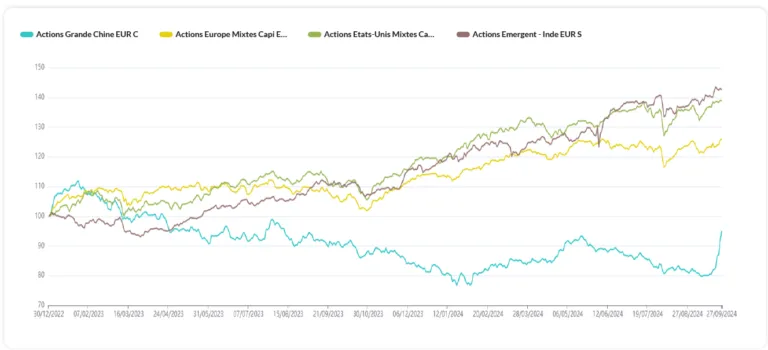
The launch of a Chinese-style “quantitative easing” (QE), a measure never seen before in this context, illustrates this awareness. This initiative aims to stabilize and support the markets, with effects expected at least through year-end. The 20% surge in the Shanghai Stock Exchange in one week is direct proof of this.
This Chinese QE is reminiscent of the massive effects that similar policies had on Western markets (Europe and the United States) between 2012 and 2018, considerably boosting equity market performance.
3. India, the Big Winner of Foreign Capital
India, for its part, is also benefiting from the influx of foreign capital, redirected from China due to trade tensions with the United States and strict post-Covid policies. India has seen its stock market rise by 30% this year, driven by its strong economic growth, estimated at 8%, and its favorable reforms.
4. A Relative Perspective on Developed Markets
Meanwhile, U.S. and European equity markets are showing signs of fatigue:
- Economic prospects in Europe are concerning, with stagnant economic indicators and growing energy uncertainties.
- In the United States, although the growth cycle has been robust, it appears to have peaked. The strong dollar is beginning to have a negative impact on U.S. multinational balance sheets, and this effect could intensify over the next 12 months.
- The caution displayed by the Fed and the ECB regarding their economic outlook, which justified their rate cuts, could also worry the markets, suggesting that more significant economic risks lie ahead.
Conclusion
From a tactical allocation perspective over the next 3 to 12 months, it could be wise to diversify portfolios from developed market equities toward emerging market equities, where China and India represent over 60%. Indeed, the recent ambitious monetary and fiscal measures taken by these two economic giants offer powerful growth drivers, while developed markets show signs of a slowdown.
Past performance is not indicative of future results. The content above does not constitute investment advice. It is an objective analysis of financial information.